Say goodbye to tired, aging eyes! How should different age groups, from 20 to 50, choose double eyelid surgery?
Cosmetic procedures are evaluated based on age, skin condition, and skincare needs to determine the most suitable treatment. Double eyelid surgery, of course, will also vary depending on age, with different options or balanced approaches.
In fact, the condition of the eyes can vary greatly between 20, 30, 40, and 50 years old. When young, one may be born with single eyelids or inner double eyelids, but as one ages, there is a chance that the eyelids will gradually sag and age, and the creases will become less noticeable. At this time, a simple double eyelid surgery cannot improve all eyelid problems.
Therefore, when evaluating double eyelid surgery, in addition to age, it is also necessary to understand eyelid thickness, skin laxity, and eyelid function. This article will start with common eye concerns of different age groups, guide you through understanding the differences between sutured double eyelid surgery and surgical double eyelid surgery, and highlight the key points of preoperative evaluation.
How to choose double eyelid surgery at ages 20, 30, 40, and 50?
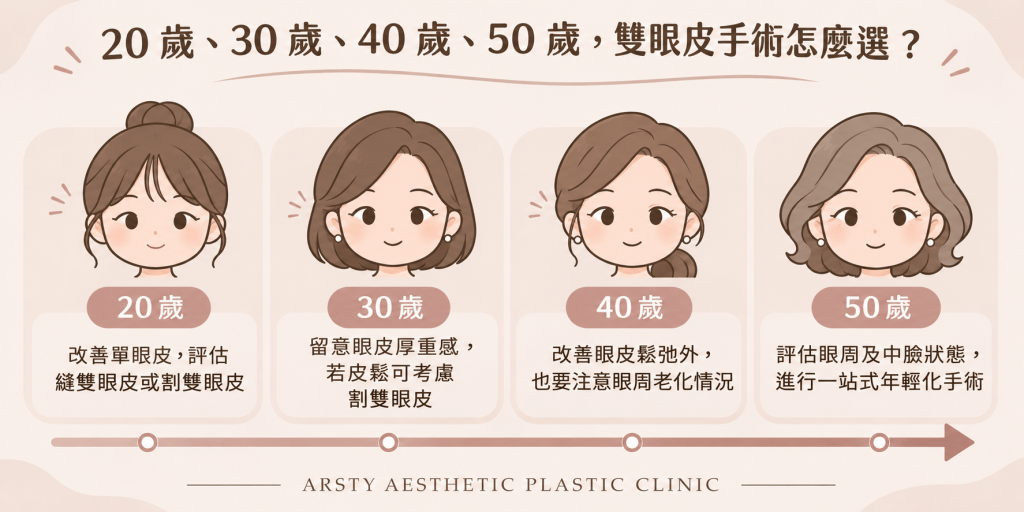
When choosing double eyelid surgery, age can be one factor to consider, but it's important to note that even within the same age group, individual eyelid thickness, fat distribution, skin laxity, and eyelid function can vary. Below, we discuss common eye concerns across age groups from 20 to 50, explaining the surgical options that can be evaluated.
Age 20: Improve single eyelids, evaluate whether to perform suture-based or surgical double eyelid surgery.
The most common concerns among people around 20 years old are having naturally single eyelids, inner double eyelids, or asymmetrical creases between the left and right eyes, and they hope to adjust their eye shape through double eyelid surgery.
If your eyelids are thin, your skin isn't noticeably loose, and you don't have excessive fat, you can discuss with your doctor about using sutures to adjust your eye shape. However, if your eyelids are thicker, you have more fat, or your overall condition isn't suitable for suture surgery, further evaluation for double eyelid surgery is necessary. Incisional surgery can remove some skin or fat tissue depending on individual circumstances; the actual area treated must be determined by the doctor.

30 years old: Pay attention to the feeling of heaviness in the eyelids and choose the appropriate surgical method.
By the age of 30, some people may find that their once-prominent double eyelid creases become unstable, or that their eyelids tend to be puffy when they wake up in the morning, making their eyes look less energetic.
If the eyelids still have good elasticity and no obvious sagging, sutures for double eyelid surgery can be evaluated; however, if the eyelids are thick, the crease is not easy to maintain, or there is excess skin, surgical double eyelid surgery can be considered. The key is not to pursue a prominent crease, but to evaluate the appropriate surgical method and crease height based on the original eye shape and conditions.
40 years old: What surgical options are available to improve sagging eyelids?
After the age of 35, some people may experience sagging upper eyelid skin, narrowing of the double eyelid crease, or drooping of the skin at the outer corner of the eye due to aging. Even those who already have double eyelids may find that the sagging skin covers the crease, making their eyes look heavy and tired.
If the primary issue is droopy eyelids, a doctor can evaluate double eyelid surgery and, if necessary, trim excess skin. However, aging-related issues are not so simple. If there is also drooping eyebrow hairs that make the upper eyelids appear heavy, further evaluation is needed.Brow lift surgeryIf the problem is due to levator palpebrae superioris muscle dysfunction, resulting in insufficient eye opening, an assessment is needed.Levator palpebrae superioris muscle surgeryThat would be a suitable option. In addition, eyelids tend to become thicker with age, in which case fat removal under the eyebrows can be considered to improve the condition.
These different surgeries have different purposes and applicable conditions. Therefore, if your eyes look tired or droopy, it is recommended that you first have a doctor assess the degree of eyelid laxity, eyebrow position and eyelid function, and then discuss the appropriate surgical method based on your individual situation.
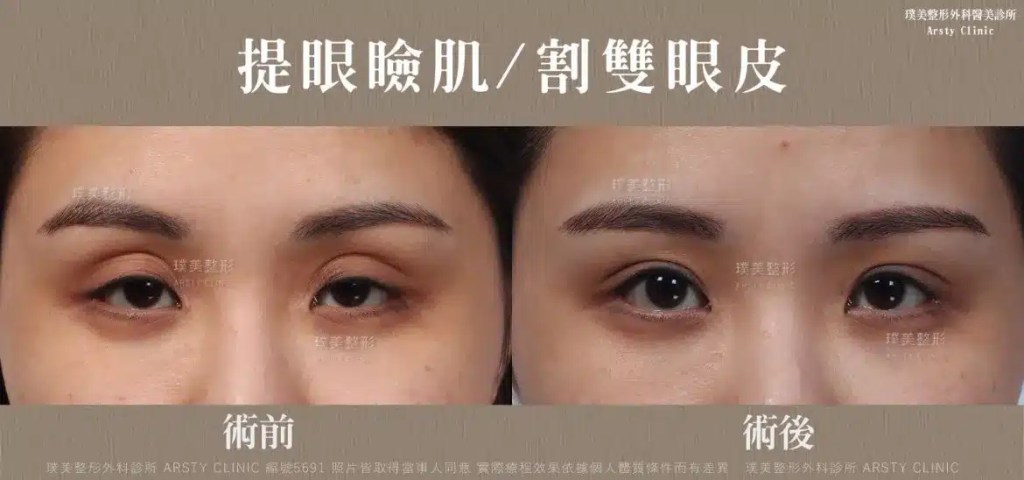
Age 50: Assess the condition of periorbital aging and choose the appropriate surgical method.
Around the age of 50, in addition to sagging upper eyelid skin and drooping eye corners, changes such as lowered eyebrow position, prominent eye bags, or sunken tear troughs may also occur, making the eyes look tired and listless. If sagging upper eyelids have already affected vision, further evaluation by a doctor is necessary.
At this stage, when evaluating double eyelid surgery, it's often not just about the shape and height of the double eyelid crease. As signs of aging gradually appear around the eyes, it's also necessary to assess the degree of eyelid laxity, eyebrow position, levator palpebrae superioris muscle function, and whether there are accompanying issues such as eye bags or tear troughs.
If the main issue is loose eyelids and excess skin covering the original double eyelid crease, it can be assessed whether double eyelid surgery or appropriate skin removal can be used to improve the condition. If it is accompanied by drooping eyebrows, eyelid fat accumulation, or abnormal levator palpebrae superioris muscle function, it may be necessary to combine brow lift, eyelid fat removal, or levator palpebrae superioris muscle surgery to more comprehensively improve the condition around the eyes.
Aging around the eyes often occurs in more than one area. If you also have problems such as protruding eye bags, sunken tear troughs, or even drooping cheekbones, you can discuss with your doctor to see if you need to combine other procedures around the eyes or midface.

Want to learn more about surgical options for different periorbital problems? You can refer to Pumei's [therapeutic treatment]. One-stop periocular rejuvenation surgeryLearn about surgical procedures for issues such as droopy eyelids, eye bags, tear troughs, and mid-face sagging, and have a doctor assess the appropriate treatment.
What are the differences between sutured double eyelid surgery and incisional double eyelid surgery? A comparison of surgical methods.
| Comparison items | suture method double eyelid | open method double eyelid |
| Surgical methods | Creases are formed through stitching | Creases formed by cutting |
| Common assessment conditions | The eyelids are thin and the degree of sagging is not obvious. | Thick eyelids, excess skin, etc. |
| Skin and fat treatment | Limited processing scope | Skin or fat treatment can be assessed as needed. |
| Postoperative recovery | Usually faster | Usually longer |
| Crease retention | It may fade or loosen over time. | Generally stable, but still affected by individual circumstances. |
Both procedures have their applicable conditions, and neither is inherently better than the other. While suture-based double eyelid surgery results in a smaller incision, it doesn't mean it's suitable for everyone; incisional double eyelid surgery can address more issues and doesn't necessarily mean it's the only option. The actual method should be determined by a doctor based on the individual's eye condition and needs.
What else should you pay attention to before getting double eyelid surgery?
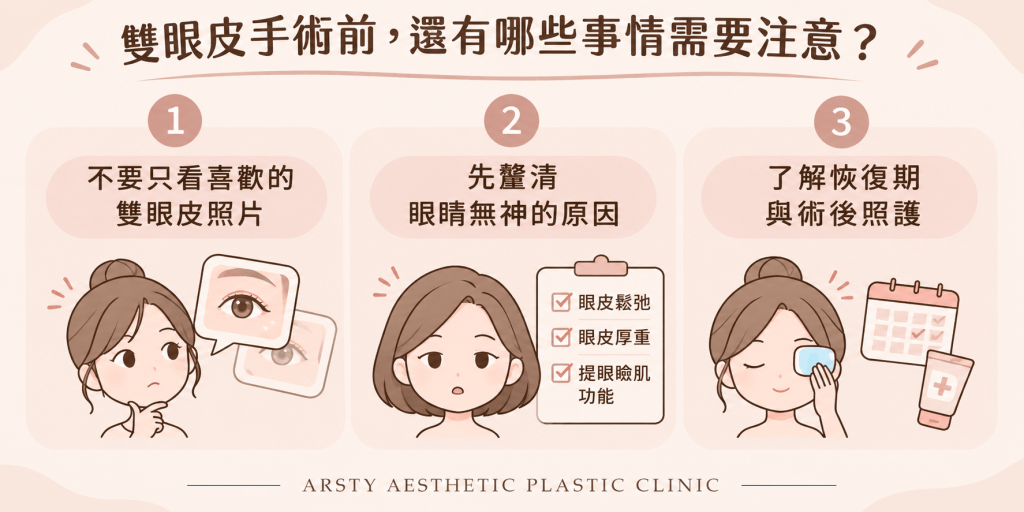
Besides age and surgical method, there are several other key points to note in the preoperative assessment.
1. Don't just look at photos of double eyelids that you like.
Everyone's eye socket condition, eyelid thickness, and eyebrow-eye ratio are different, so the same crease may look different on different people. When communicating with your doctor, you can provide your preferred eye shape as a reference, but it is still best to consider your own conditions before proceeding with surgery.
2. First, clarify the reason for the dullness in the eyes.
Tired eyes aren't always caused by single eyelids; they could also be related to droopy eyelids, droopy eyebrows, or eyelid dysfunction. Identifying the primary cause is crucial for discussing appropriate treatment.
3. Understanding the recovery period and postoperative care
Post-operative swelling, bruising, or temporary unnatural-looking creases may occur, and recovery time will vary depending on the surgical method and individual circumstances. Before surgery, the care plan should be confirmed. If sutures are required, follow-up appointments should be confirmed in advance, as well as whether there will be sufficient rest time after surgery. Follow the doctor's instructions for wound care.
How to choose a double eyelid surgery? A doctor's assessment of your eye condition is more important.
From age 20 to 50, different stages may present different eye concerns, but there is no fixed age-appropriate approach to double eyelid surgery. A 20-year-old may need to correct naturally single eyelids, while a 40 or 50-year-old may require further evaluation for aging issues around the eyes; even at the same age, the suitable surgical method may differ.
If you are considering double eyelid surgery, it is recommended that a doctor first examine your eyelid thickness, skin laxity, eyebrow-eye ratio, and eyelid function before discussing the feasibility of suture or incision for double eyelid surgery.
Pumei Medical Aesthetics Clinic offers one-on-one doctor evaluations.We can discuss surgical plans based on your individual eye condition and needs. Through a complete pre-operative consultation, you can understand the limitations, recovery period, and potential risks of different surgical methods, and then make a choice that suits you.