


Juvelook - Refined skincare, restoring natural suppleness and radiance.

Surgery timeApproximately 30-60 minutes

Anesthesia methodsAccording to the treatment method

Suture removal timeNo need to remove stitches

Postoperative recoveryNo recovery period

JuvelookCombined Polydi-lactic acid(PDLLA)and Hyaluronic acid (HA)This treatment works on the skin through injection, addressing both hydration and skin texture management needs. Treatments can be tailored to different areas and individual skin conditions, making it suitable for those who wish to improve dryness, fine lines, enlarged pores, rough skin texture, and those seeking a natural, plump appearance and overall skin quality.
What is Juvelook?
By combining different product characteristics with different injection levels, doctors can create customized plans based on the treatment area, skin condition, and individual needs, so that the treatment is not just about filling in, but also about taking into account skin texture and overall naturalness.
Juvelook What are the blue and black bottles of Juvederm?
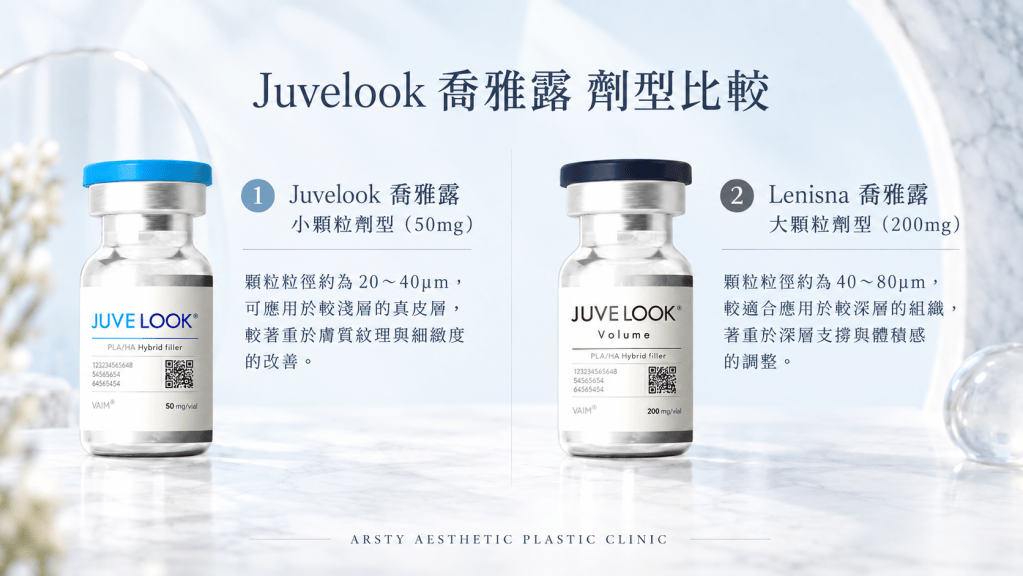
① Juvelook | Small granule form (50mg)
The small particle dosage form, commonly known as the "blue bottle," uses a finer PDLLA particle design, with a particle size of approximately... 20~40μmIt can be applied to the shallower dermis.
② Lenisna (200mg) | Large Particle Formulation
The large-particle dosage form, commonly known as the "black bottle," uses larger PDLLA particles, with a particle size of approximately... 40~80μmIt is suitable for use in deeper tissues.
Why is there a difference between 50mg and 200mg in the bottles that look similar?
50mg and 200mg representContents of lyophilized powder in the bottleThis is not the bottle's capacity. Although Juvelook and Lenisna use bottles of similar size, the actual contents differ due to variations in granule design and product specifications.
Juvelook The mechanism of action of Qiao Yalu
HA Hyaluronic Acid | Replenishes moisture and improves skin hydration
Juvelook's non-crosslinked hyaluronic acid (HA) has excellent water absorption and retention properties. After injection, it can help increase the skin's moisture content, making dry and rough skin more hydrated and soft, while also providing a plumping sensation in the early stages of the treatment.
PDLLA (Polydihydroxyl lactic acid) | Stimulates collagen production and gradually improves skin texture
PDLLA (polydihydroxyl lactic acid) is another core ingredient in Juvelook. When injected into appropriate tissue layers, it can gradually stimulate the skin's own collagen production and restructuring. Over time, it provides progressive skin management for skin problems such as fine lines, pores, rough skin texture, unevenness, and loss of elasticity, resulting in a more refined, smooth, and naturally supple complexion.
Juvelook What problems can Qiao Yalu improve?
Juvelook Blue Bottle | Focuses on skin texture, fine lines, and superficial wrinkles
The blue-bottled Juvelook formula uses finer PDLLA particles, making it more suitable for application to the dermis. It focuses on improving skin texture and smoothness, and common assessable issues include:
- Large pores and rough skin
- Fine lines around the eyes, dryness
- Acne scars, uneven skin texture
- shallow depressions such as tear troughs
- Neck wrinkles and fine lines
- Dry skin, lack of elasticity and radiance
Lenisna Black Bottle | Focuses on deep depressions and tissue support
The black bottle of Lenisna features a larger particle design, which is more geared towards deeper tissues and volume support needs. It can be applied according to individual facial conditions:
- Sunken cheeks, loss of facial volume
- Sunken temples
- Nasolabial folds and deeper lines
- Insufficient contour support
- Problems with uneven skin texture on certain parts of the body
What's the difference between Juvelook and Juvéderm?
In terms of treatment, Juvederm focuses more on skin texture and collagen management, such as fine lines, large pores, rough skin texture, acne scars, or those who want to increase skin elasticity. Treatments can be assessed based on individual circumstances. Juvederm, on the other hand, is mainly used to replenish tissue volume and refine facial contours, such as the cheekbones, chin, lips, temples, or nasolabial folds.
In simple terms, Juvederm focuses on improving skin texture, while Juvederm focuses on filling and contouring. They have different uses, and it's not a matter of which is better; rather, it depends on whether you want to improve skin texture, depressions, or contouring issues, and a doctor will assess the appropriate treatment.
Juvelook Treatment Instructions
Pre-treatment | Physician Assessment and Treatment Planning
During the treatment | Injection will be performed after confirming the skin condition.
Post-treatment | Strengthen moisturizing and sun protection, and wait for the skin to gradually recover.
After the treatment, temporary redness, swelling, needle marks, tenderness, or local bruising may occur at the injection site, which will usually subside gradually over time. It is recommended to strengthen moisturizing and sun protection after the procedure, and temporarily avoid high-temperature environments, strenuous exercise, alcohol consumption, and excessive massage of the treated area. Subsequent treatments will be scheduled according to the doctor's assessment, and changes in skin hydration, smoothness, and elasticity can be observed.
Preoperative precautions
- A complete evaluation by a physician should be conducted before the course of treatment.Proactively inform the doctor of your current health status, allergy history, skin diseases, past injection treatment experience, and any medications or health supplements you are currently using, so that the doctor can assess whether you are suitable for the treatment.
- Treatment should be postponed if there is infection, inflammation, or wound at the treatment site.If there is obvious acne inflammation, rash, broken skin, infection or other acute skin problems in the injection area, a doctor should evaluate the patient after the symptoms improve.
- You should proactively inform others if you are using medications or health supplements that may affect blood clotting.If you are taking anticoagulants, antiplatelet drugs, or other products that may increase the risk of bruising or bleeding, you should not stop taking them on your own. You should inform your doctor in advance and follow their professional instructions.
- You should inform us in advance if you have recently undergone other cosmetic procedures.If you have recently received hyaluronic acid, collagen-boosting agents, botulinum toxin, laser, electrotherapy, or other injections and cosmetic procedures, you should inform us of the time and location of the treatment so that the doctor can arrange appropriate treatment intervals.
- Please allow time for recovery if you have important events in the near future.Temporary reactions such as local redness, swelling, bruising, or needle marks may occur after the injection. If you have an important trip planned in the near future, you can discuss the treatment schedule with your doctor in advance.
- You should proactively inform others if you are pregnant, trying to conceive, or breastfeeding.The assessment will be conducted by a physician based on the individual's health condition and the suitability of the product.
Postoperative precautions
- Temporary injection reactions may occur after the treatment course.Redness, swelling, tenderness, needle marks, or bruising may occur at the injection site. In most cases, these symptoms will gradually subside over time. The actual recovery varies depending on individual constitution and the treatment site.
- Keep the injection site clean and avoid excessive contact.After the treatment, avoid repeatedly pressing, rubbing, or scratching the injection area, and follow the doctor's instructions for cleaning and care.
- Avoid high temperatures and strenuous exercise for a short period of time.After treatment, it is recommended to temporarily avoid hot springs, saunas, ovens, strenuous exercise, and excessive alcohol consumption to reduce the possibility of worsening redness or bruising.
- Daily skincare should focus on gentle methods.In the short term, avoid excessive exfoliation, acids, retinol, retinoic acid, or other highly irritating skincare products. Resume use once your skin condition has stabilized.
- Do basic moisturizing and sun protectionMaintaining adequate hydration and daily sun protection after treatment helps the skin recover in a stable state.
- Other cosmetic procedures should be spaced out appropriately.If you plan to receive laser, electrotherapy, skin resurfacing, or other injectable treatments, it is recommended that you first confirm the appropriate treatment time with your doctor.
- If persistent or obvious abnormal reactions occur, you should return to the doctor as soon as possible.If the treated area experiences persistent and worsening redness, swelling, pain, noticeable lumps, abnormal skin color, oozing, or other discomfort, you should contact the clinic as soon as possible for evaluation by a doctor.