Will M22 IPL cause hyperpigmentation? A complete analysis of common reactions, post-treatment care and precautions.
After undergoing M22 color light therapy, some people find that their original spots have suddenly darkened, or even that small dark spots have appeared on their face. It's understandable to worry that this is "rebound pigmentation." In fact, darkening of pigmentation after M22 color light therapy does not necessarily mean rebound pigmentation. Sometimes, it simply means that the original pigment spots have become more noticeable temporarily after being affected by the light energy.
However, post-inflammatory hyperpigmentation is indeed a possibility after IPL treatment, especially if the skin is strongly stimulated and sun protection is not properly implemented after the procedure. What changes are considered normal post-operative reactions? When should special attention be paid? The following is a summary of common reactions to M22 IPL, the causes of hyperpigmentation, and post-operative care methods to give you a basic understanding before undergoing the treatment.
Is the blackening after M22 color photolithography due to reverse shading?
It's possible, but not guaranteed, that M22 IPL treatment will cause post-treatment hyperpigmentation. M22 IPL uses specific wavelengths of light energy to act on the skin, commonly targeting issues such as pigmentation and redness. After treatment, existing spots may temporarily darken, even appearing as small black dots. This is because the pigment, after being exposed to the light energy, will gradually be eliminated during subsequent metabolic processes.
Therefore, if the original spots simply darken and then gradually fade, this is usually a common change after treatment. However, if the skin becomes inflamed after being irritated, resulting in persistent pigmentation, it may be considered post-inflammatory hyperpigmentation (PIH).
The two may look very similar, and you may not be able to tell the difference just by looking in the mirror. If the color does not fade, or if you experience obvious redness, swelling, or pain, it is recommended to return to your doctor for confirmation.
Why do pigment changes occur after M22 color processing?
When some people see their spots darken after treatment, they worry, "Is my skin overactive?" But it's not necessarily a case of hyperpigmentation. Common causes can be roughly divided into the following categories.
1. The original spots temporarily darkened.
When using M22 IPL (Intense Pulsed Light) to treat pigmentation problems, the light energy acts on the melanin in the skin. After treatment, freckles, sunspots, and other pigmentation spots may indeed become darker, but these pigmentations usually fade gradually with skin metabolism.
Therefore, if the existing spots have simply darkened without any obvious redness or pain, you can take care of your skin as instructed by your doctor and do not need to rush to use acid-based or exfoliating products.
2. Skin irritation can lead to post-inflammatory hyperpigmentation.
Another situation that people are more concerned about is "post-inflammatory hyperpigmentation." When the skin is stimulated by treatment, if a significant inflammatory response occurs, it may further increase melanin production, leading to post-inflammatory hyperpigmentation.
This is why IPL treatments require adjusting parameters based on individual skin tone, skin condition, and treatment goals, rather than simply pursuing higher energy settings.
Third, inadequate sun protection after surgery.
After an IPL treatment, the skin needs time to recover. Therefore, people who already have blemishes or uneven skin tone should not neglect sun protection just because they have finished the treatment. Frequent sun exposure during this period may further stimulate melanin production and increase the chance of pigmentation.
Postoperative reactions | What are the common reactions after M22 color Doppler laser treatment?
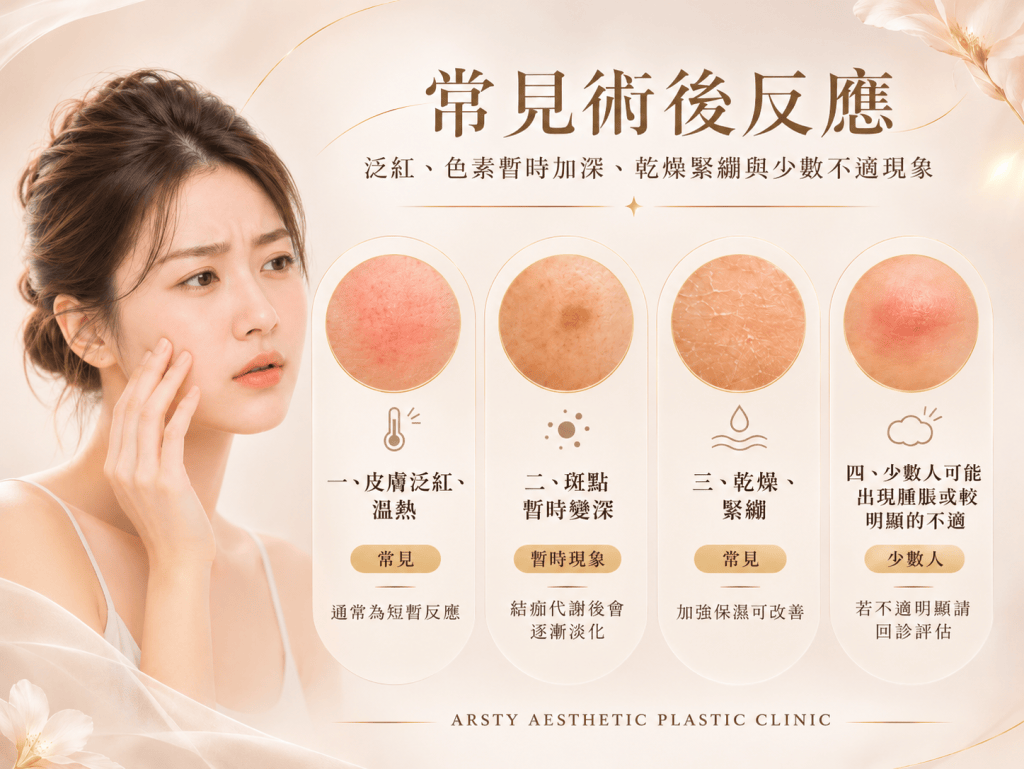
It's not uncommon to experience temporary changes in the skin after an M22 treatment. Individual reactions vary and are influenced by the treatment area, energy settings, and the patient's original skin condition.
1. Skin redness and warmth
After treatment, you may feel a warm sensation on your skin or see slight redness at the treated area. However, this will usually subside over time.
If you feel a noticeable heat sensation, you can apply ice as directed by the clinic after the procedure, but do not leave ice directly on your skin for an extended period of time.
II. Spots temporarily darken
The original spots may darken after treatment, which is a situation that many people easily mistake for "rebound hyperpigmentation". However, if there is no persistent obvious redness, swelling, pain or other inflammatory reaction, they will usually fade gradually with subsequent metabolism.
3. Dry and tight
Some people may experience dryness or even tightness in their skin after treatment. In this case, a simple skincare routine is sufficient; focus on moisturizing. Choose products that are gentle on your skin and avoid layering too many products at once.
IV. A small number of people may experience swelling or more noticeable discomfort.
If significant redness, swelling, pain, or even blisters or wounds occur after treatment, it is not considered a simple, mild postoperative reaction.
In this situation, it is not recommended to apply medication or use other products on your own. You should contact the clinic where you received the original treatment directly so that the doctor can assess your skin condition.
Post-operative care | How to care for yourself after M22 color laser treatment?
After completing the M22 treatment, there's no need to pursue complicated maintenance. Instead, it's more important to adhere to the principle of "simple and low-irritation".
1. Moisturize well
If your skin feels dry or tight, you can use a gentle moisturizer. There's no need to rush back to your regular skincare routine. The most important thing is to stabilize your skin first, and then resume your daily skincare routine as advised by your doctor.
II. Sunscreen is essential.
To prevent pigmentation issues from becoming more pronounced, it's crucial to protect yourself from the sun after the procedure. Remember to use sunscreen when going out, and you can also use hats and parasols to reduce direct sunlight exposure. Reapply sunscreen as instructed by the product when spending extended periods outdoors.
3. Temporarily avoid using acid-based products and exfoliating scrubs.
After treatment, remember not to rush to use acid-based products to "accelerate metabolism." Products such as retinoic acid, glycolic acid, salicylic acid, or exfoliating products may increase skin irritation. Therefore, whether to stop using them after the procedure and when to resume use should be based on the intensity of the treatment and the individual's skin recovery, following the post-treatment instructions provided by your doctor.
4. Do not pick at black spots or scabs.
If the spots darken or develop a scab-like condition, simply let them fall off naturally. Picking or scratching them can only irritate the skin. If this leaves wounds, it may increase the chances of future pigmentation.
5. Temporarily avoid high-temperature environments
In the short term after treatment, avoid high-temperature activities such as soaking in hot springs, saunas, and steam rooms, and do not keep your face in a very hot environment for extended periods. If you are prone to redness or have a significant post-operative reaction, you should allow your skin to rest.
Who is suitable for an M22? What situations require special attention?
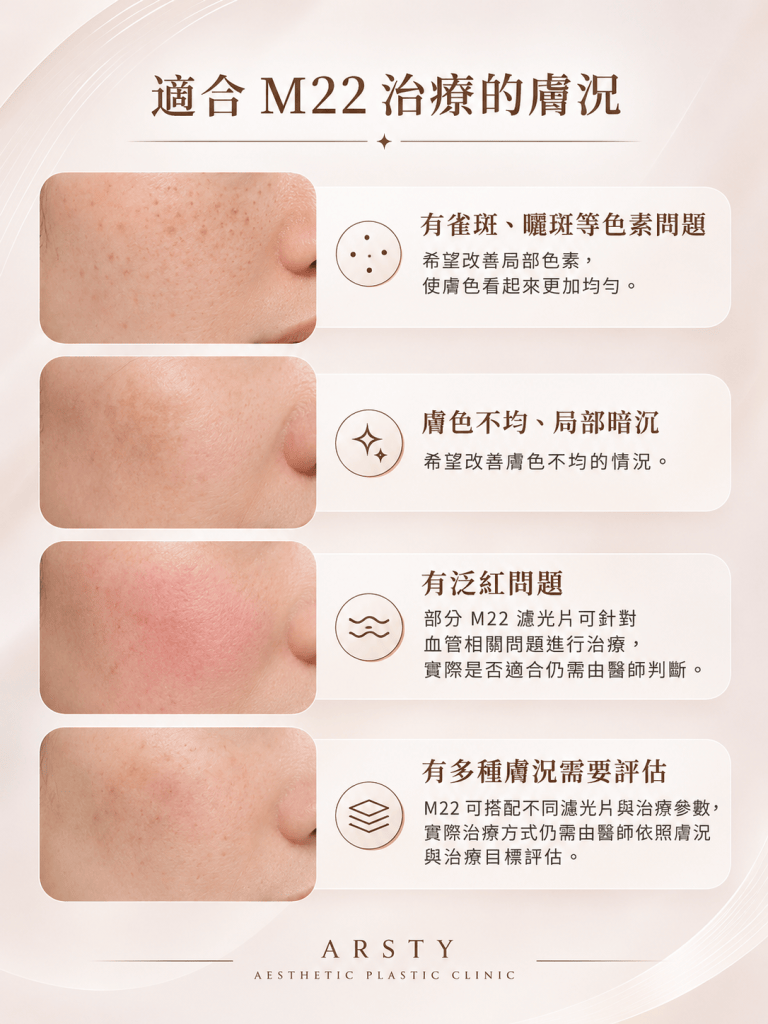
M22 Intense Pulsed Light Treatment isn't something you can just start doing whenever you see spots; a pre-treatment skin assessment is equally important. Generally, if you have any of the following skin concerns, you can discuss with your doctor whether you are a suitable candidate for M22 Intense Pulsed Light Treatment:
- For those with pigmentation issues such as freckles and sunspots: the goal is to improve localized pigmentation and make the skin tone appear more even.
- Uneven skin tone, localized dullness: Desiring to improve uneven skin tone.
- Redness issue: Some M22 filters can treat vascular-related problems, but whether they are suitable for a patient still needs to be determined by a doctor.
- There are various skin conditions that need to be evaluated: M22 can be paired with different filters and treatment parameters, but the actual treatment method still needs to be evaluated by a doctor according to the skin condition and treatment goals.
However, if you have recently experienced significant sunburn, sun damage, or inflammation or wounds at the treatment site, you should inform your doctor first.
In addition, if you regularly use skincare products such as retinoic acid or glycolic acid, or have any regular medications, you should inform your doctor before starting treatment. Some medications may increase the risk of photosensitivity; whether to stop taking the medication or adjust the treatment course should be determined by your doctor. Do not stop taking the medication on your own.
If you see darker spots after an M22 IPL treatment, it doesn't necessarily mean post-inflammatory hyperpigmentation. The original pigmentation may temporarily darken after being exposed to light energy, which is a normal post-treatment change. However, if the skin becomes irritated and develops persistent pigmentation, then it's more likely due to post-inflammatory hyperpigmentation.
Don't rush into "intensive care" after the procedure. Focus on moisturizing and sun protection, avoid using acids or exfoliating, and don't pick at or scratch the darkened spots. If you notice the color continuing to darken, or if you experience significant redness, swelling, pain, or blisters, it is recommended to return to your doctor as soon as possible to determine the cause and arrange subsequent treatment.
If you have any questions about whether M22 IPL is right for you, or about changes in your skin after the procedure, please feel free to consult with Pumei Plastic Surgery Clinic. Our professional doctors will assess your individual skin condition, pigmentation issues, and treatment needs to plan a suitable treatment course, making both treatment and post-treatment care more informed!
M22 Color Filtering and Anti-Black Frequently Asked Questions & Answers
Q1: Is it normal for M22 to turn black after use?
Not necessarily. It's common for existing spots to temporarily darken after treatment; however, persistent pigmentation could be related to post-inflammatory hyperpigmentation. If you're unsure, it's recommended to return for a follow-up appointment.
Q2: How long will it take for the M22 color-reflecting and blackening effect to fade?
If the pigmentation spots only temporarily darken after treatment, they will usually fade gradually as the skin metabolizes. However, if post-inflammatory hyperpigmentation develops, the recovery time may be longer, and there is no fixed number of days that applies to everyone.
Q3: Can I apply whitening products after getting M22 injections?
It is not recommended to use large amounts of whitening or acid-based products immediately after the procedure. Immediately after the treatment, focus on moisturizing, sun protection, and minimizing irritation. Once the skin has recovered, resume other skincare routines as advised by your doctor.
Q4: Can I apply makeup after using the M22 color laser?
Whether or not you can wear makeup depends on your skin condition after the procedure. If there is only slight redness, you can apply makeup normally in some cases, following the clinic's instructions. However, if there is broken skin, scabbing, blisters, or other issues, it is not recommended to apply makeup yourself; you should consult your doctor first.
Q5: Who is more likely to experience blackening after M22 color tinting?
Whether pigmentation occurs after M22 IPL treatment depends on factors such as skin tone, original skin condition, treatment parameters, and post-treatment care. Generally, individuals more prone to post-inflammatory hyperpigmentation should have their skin condition and related risks assessed by a doctor before treatment. If you have a history of post-treatment pigmentation, you should inform your doctor before the treatment.