Can the Deme Microneedling Pen improve acne scars? Analysis of acne scar treatment principles, effects, and post-treatment care.

Can the Demei microneedling pen improve acne scars? If acne finally subsides but leaves behind uneven acne scars, large pores, and even makes it difficult to apply foundation, many people will likely start looking for a suitable acne scar removal treatment. Especially for more noticeable pitted scars, simply relying on spot-fading skincare or treating surface pigmentation is often insufficient to improve the skin's depressions. Therefore, it's necessary to address the depth of the acne scar formation and the skin's repair mechanism.
There are many common acne scar problems. Some people mainly have red or brown acne marks, while others also have large pores, rough skin texture, and ice pick, carriage, or rolling pitted scars. When faced with different types of acne scars, you should not just look at which treatment is popular, but rather understand the type of acne scar, the depth of the scar, and your skin condition before choosing a suitable treatment method.
This article will explain the working principle of the DeMei microneedle pen for improving acne scars, the types of acne scars it is suitable for, common treatment sites, treatment effects, recovery period and post-treatment care, and will also summarize common questions before the treatment, so that you can master the key points of the DeMei microneedle acne scar treatment course in one go!
How are acne scars formed? Why do scars remain even after acne clears up?
The formation of acne scars is usually related to the degree of skin inflammation, the speed of repair, and whether pimples are repeatedly squeezed. When pimples are inflamed, the skin tissue is stimulated. If the inflammation lasts for a long time, is deep, or if collagen production is insufficient or uneven during the repair process, it may leave pigmentation, redness, or even pitted or raised scars.

Common acne scars can be roughly divided into the following types:
- Red acne marks:Inflammation causes dilation or proliferation of capillaries, leaving red or pink marks on the skin.
- Brown acne scars:Inflammation leads to pigmentation, leaving behind dark brown or light-colored discoloration after the acne subsides.
- Superficial pitted scars:When the skin is repairing itself, there is insufficient collagen, resulting in slight depressions and unevenness on the surface.
- Deep pitted scars:The indentations are deep and the edges are distinct. Common types include ice pick type, carriage type and rolling type acne scars.
- Hypertrophic acne scars:Excessive tissue proliferation during the repair process results in raised, hard scars.
Different types of acne scars require different treatment levels: simple red and brown acne scars can be faded by destroying proliferating capillaries and accelerating melanin production; pitted acne scars are related to the loss of dermal tissue and collagen, so they need to be further stimulated to repair the skin and remodel collagen.
What is the working principle behind the Demei microneedle pen for improving acne scars? Which types of acne scars is it suitable for improving?
The core principle behind the Demei microneedling technique for improving acne scars lies in stimulating the skin's natural repair mechanism through microneedling. During the treatment, the fine needles quickly and vertically penetrate the skin, creating tiny micro-invasive channels in the treatment area. This stimulates the skin to enter the repair phase, promoting collagen and tissue rearrangement, and gradually smoothing out depressions. Furthermore, the temporary micro-channels created during treatment significantly enhance the absorption efficiency of topical repair serums or growth factors, strengthening the tissue reconstruction effect.
When the Demae microneedling device is applied to the acne scar area, the skin will trigger a series of repair responses:
- Establish a minimally invasive channel:Microneedles quickly penetrate and exit the skin, creating tiny punctures.
- Initiate repair mechanism:When the skin is stimulated, it begins to undergo a natural tissue repair process.
- Promote collagen remodeling:As the repair process continues, it can improve the depressions and roughness of the skin caused by collagen loss.
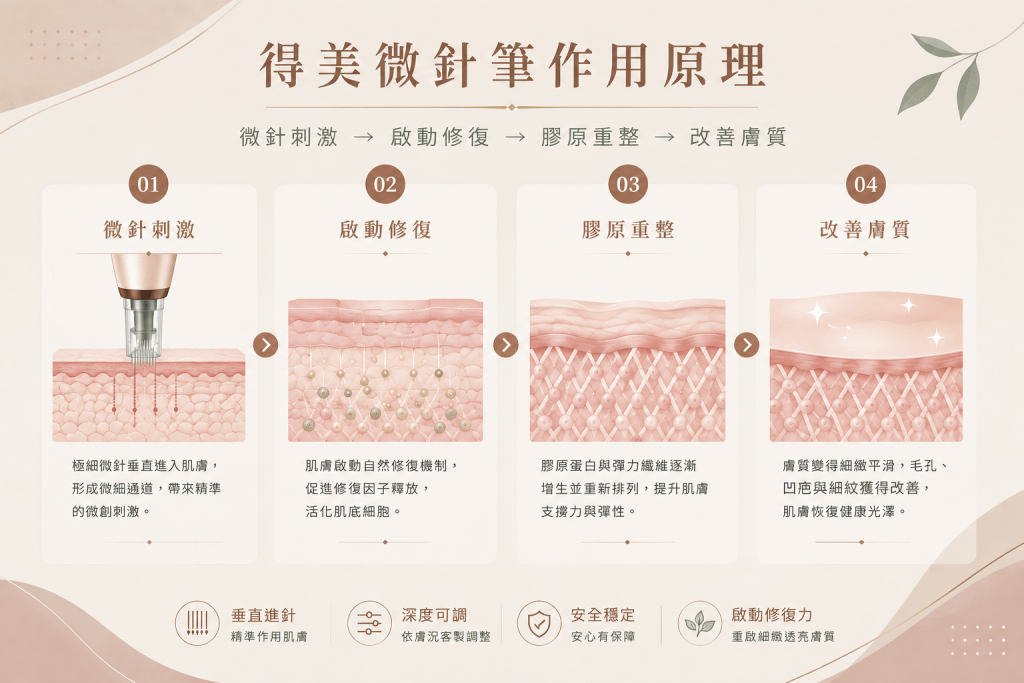
The Demei microneedle is suitable for treating pitted acne scars. If what remains after the acne has subsided is not just acne marks, but also has obvious unevenness to the touch and makes foundation easy to stick to the pits, a doctor can assess whether microneedling is suitable.
Common conditions that can be improved include:
- Superficial pitted scars:For skin with slight depressions or uneven texture, microneedling can stimulate collagen remodeling.
- Carriage-shaped acne scars:For wider depressions with relatively clear borders, treatment can be planned according to the depth of the scar.
- Rolling acne scars:The skin surface has a wavy, irregular bumpy texture, which can be improved through a comprehensive treatment.
- Ice pick-type acne scars:Ice pick acne scars are usually deep and have small openings, making them more difficult to treat. Treatment depends on the specific situation and may require additional acne scar treatments.
- Large pores and rough skin texture:If the skin also has prominent pores and uneven skin texture, it can also improve the overall skin texture while improving scars.
How long does it take to see results from the Demei microneedling technique for improving acne scars? How long is the recovery period?
The effects of the Demei microneedling technique on acne scars require waiting for the skin to complete its repair and collagen remodeling process. The results will not be immediately apparent on the day the treatment ends. It takes about 3 to 4 weeks after the treatment to start to feel the improvement in skin texture or superficial fineness. However, the improvement of pitted scars requires a slow accumulation as the tissue repairs itself. Therefore, for the obvious collagen remodeling and accumulation effect on pitted acne scars, it is usually necessary to have 3 to 6 complete treatments (each with an interval of 4 to 6 weeks) to more easily observe significant changes.
The number of treatment sessions required will vary depending on the depth, type, treatment area, and individual healing speed of acne scars. Shallow pitted scars and rough skin may be easier to observe changes in; however, deeper, longer-standing, or mixed-type acne scars may require multiple treatments, or even a combination of other acne scar treatments.
Common short-term reactions after the treatment include redness, dryness, tightness, slight swelling, peeling, or local scabbing. Tiny bleeding points may also appear in some treated areas. In most people, the redness will significantly subside or disappear within 24 to 48 hours. Tiny peeling may occur later. Avoid washing your face and using irritating skincare products for 24 hours after the procedure. The overall recovery period is about 3 to 5 days.
How should I care for my skin after receiving the DeMei microneedling treatment?

Keeping the skin clean and dry, providing gentle hydration, and ensuring adequate sun protection while minimizing irritation are important post-microneedling care principles. Because the skin is more sensitive in the short term after microneedling stimulation, skincare should focus on gentle, simple products, avoiding high-concentration acids or functional skincare products.
Postoperative care can take several aspects into consideration:
- Gentle cleaning:Do not wash your face with water for 6 to 8 hours after the procedure. If necessary, you can gently clean it with saline solution. Avoid vigorous rubbing or scrubbing of the treated area and keep your skin dry for 24 hours.
- Enhanced moisturizing:Choose moisturizing products with simple ingredients and low irritation to reduce dryness and tightness of the skin.
- Effective sun protection:After treatment, the skin is more sensitive to sunlight. When going out, avoid direct sun exposure, and take precautions against sunburn and physical shielding to reduce the risk of pigmentation.
- Stop using irritating skincare products:Avoid using retinol, retinoic acid, fruit acid, salicylic acid, whitening, exfoliating or other highly irritating products in the early postoperative period.
- Avoid scratchingIf the skin becomes dry, flaky, or develops small scabs, allow the skin to metabolize naturally and avoid peeling them off with your hands.
- Avoid high temperaturesAvoid hot springs, saunas, swimming, or washing your face with excessively hot water for one week after the surgery to prevent infection or irritation.
Frequently Asked Questions about the Demei Microneedle Acne Scar Treatment
Q1: Can the Demei Microneedle completely eliminate acne scars?
Microneedling can improve pitted acne scars and skin texture, but the degree of improvement is affected by the type, depth, age of the scar, and individual healing ability. Deep or old scars require long-term planning. If the acne scars are deep or multiple types are present, the doctor may combine other treatments to achieve better fading results.
Q2: Can I get a microneedle treatment if I have acne?
If the treatment area is in a state of obvious inflammation, suppuration, infection, or broken skin, the acne should be controlled and the skin condition stabilized first. Then, a doctor will assess whether it is suitable to use a microneedling device to improve enlarged pores or pitted acne scars.
Q3: Will the treatment of acne scars with the Deme Microneedle Pen be painful?
The process of treating acne scars with the Deme Microneedling device is usually less painful. However, you may still feel a stinging sensation, pressure, or local discomfort during the procedure. The actual experience will be affected by the depth of treatment, the treatment site, and your individual pain sensitivity.
Q4: Will my skin darken after the Demei microneedling procedure?
The risk of post-inflammatory hyperpigmentation (post-inflammatory hyperpigmentation) after the Dememicroneedling procedure is extremely low. However, the risk may increase if the skin is irritated, exposed to excessive sunlight, repeatedly scratched, or if post-treatment care is inadequate. Therefore, it is important to protect the skin from the sun, moisturize, and follow the instructions of your medical professional after the treatment.
Q5: How many sessions of the Demei microneedling treatment are needed to improve acne scars?
Superficial acne scars or skin texture improvement usually show significant improvement after 3 to 5 treatments; deeper pitted scars or severe acne scars usually require 4 to 6 or more treatments, and a doctor will assess whether more treatments are needed or whether other cosmetic procedures can be combined.
Choose the Demei Microneedle Acne Scar Treatment to improve acne scars and skin texture!
The Derma Microneedle Pen uses microneedles to stimulate skin repair and collagen remodeling, targeting pitted acne scars, enlarged pores, and uneven skin texture. Improving acne scars requires time and consistent care, along with proper post-treatment care, acne control, and a personalized treatment plan, to gradually improve skin texture towards a smoother and more refined appearance.
Want to know if your pitted scars, large pores, or rough skin are suitable for the Derma Microneedling treatment? Schedule a professional consultation with Dr. Park Mi now! The doctor will plan a suitable treatment based on your scar type, depth, and skin condition. Or, check out more information about Derma Microneedling treatments to learn more about its working principle, application method, and post-treatment care, and find the right solution for your acne scar improvement!