What are Juvederm nodules? Why do they occur? Common causes, treatments, and precautions.
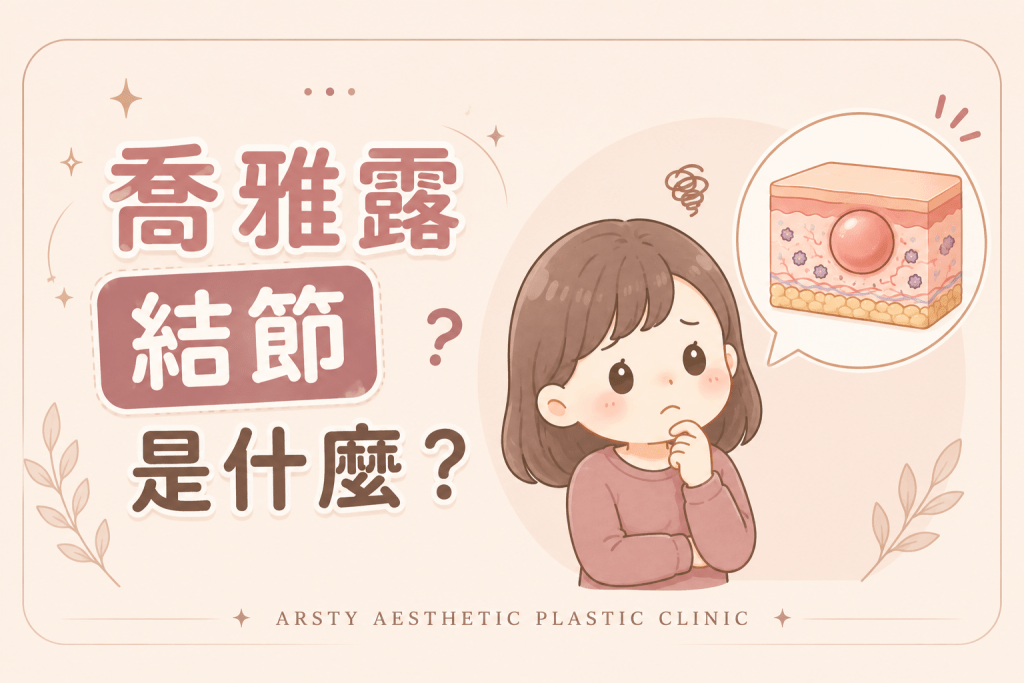
Juvelook is an injectable medical device that has gained attention in recent years, and many people consider it for skin care and condition management. However, when searching for related information, one often sees keywords such as "Juvelook nodules," "Juvelook lumps," and "granules after Juvelook injections," causing many people to worry about whether lumps or other local reactions may occur after the injection before undergoing treatment.
Actually, feeling a lump or granular texture after injection doesn't necessarily mean you have Juvederm nodules. Swelling and changes in sensation that appear shortly after treatment may be related to a temporary tissue reaction caused by the injection; however, if the lump persists, becomes more noticeable, or is accompanied by symptoms such as redness, swelling, heat, or pain, further evaluation by a professional physician is necessary. So what exactly are Juvederm nodules? Why do they occur? And how should they be treated? This article will guide you through the common causes, treatment methods, and precautions for Juvederm nodules.
What are Juvederm nodules? If I feel a hard lump after an injection, is it a nodule?
Juvederm primarily contains poly-D,L-lactic acid (PDLLA) and hyaluronic acid (HA). The term "Juvederm nodule" generally refers to a persistent subcutaneous lump, granular texture, or raised area that appears at the injection site after treatment. However, feeling a lump after injection does not necessarily indicate a nodule; further assessment by a physician is required based on the time of appearance, texture, and whether it is accompanied by inflammatory symptoms.
It is important to note that nodules are not a single disease, but rather a clinical manifestation. Recent literature also indicates that PDLLA-related nodules need further classification based on the time of onset, whether inflammation is present, and clinical presentation, and cannot be directly diagnosed as granulomas simply by observing a lump.
Why do Juve's nodules occur? There are 5 common reasons.
The formation of Juvederm nodules has many causes and cannot be simply attributed to "bad products" or "unsuitable constitution." Current literature on PDLLA indicates that product preparation methods, injection techniques, injection depth, material distribution, and individual tissue reactions can all influence nodule formation.
1. Inappropriate injection depth
Different areas have different skin thickness, fat distribution, and tissue structure, so the appropriate injection depth needs to be considered.
If the injection depth or layer is inappropriate, it may increase the possibility of uneven local material distribution, noticeable tactile discomfort, or uneven appearance, especially in areas with thinner skin, where evaluation by a physician familiar with facial anatomy is necessary.
2. Uneven distribution in a single region
If the injected material is concentrated in a localized area rather than evenly distributed across the intended treatment zone, it may create a localized granular feel or lumps.
The injection of PDLLA-type materials requires consideration of dosage, distribution, and treatment area; it is not simply a matter of "the more the better." Therefore, the treatment plan, injection dosage, and material distribution all need to be assessed by a physician based on the treatment site and individual circumstances.
3. Product preparation and operation methods
The use of PDLLA-type materials involves steps such as product recombination, dilution, settling, and injection. Both research and expert consensus indicate that proper product preparation and injection techniques are crucial for reducing local adverse reactions such as nodules.
Therefore, in addition to confirming the product name before undergoing treatment, you should also understand whether the product is legally approved and whether the evaluation and injection are performed by a qualified physician.
4. Individual organizational response
Everyone's immune response and tissue condition are different. Even if the same products and treatments are used, it does not mean that everyone's response will be exactly the same.
PDLLA-related nodules can present with different clinical forms, such as non-inflammatory local lumps, or they may be accompanied by inflammation or immune responses; in rare cases, they may be related to factors such as infection. Therefore, even if the lump appears some time after the treatment, it should not be simply regarded as a general postoperative reaction and should still be evaluated by a physician.
5. Infection or other tissue problems
If the lump is accompanied by significant redness, pain, fever, oozing, or recurring swelling, the doctor needs to rule out infection or other problems.
If the lump is accompanied by significant redness, swelling, pain, heat, oozing, or recurring swelling, the doctor will need to further rule out infection or other tissue problems. If symptoms persist or gradually worsen, you should seek medical attention as soon as possible for evaluation and avoid self-massage or other treatments.
Do I have nodules? How can I distinguish between normal swelling after injection and nodules?
It is not uncommon for mild swelling, bruising, tenderness, or temporary changes in sensation to occur at the injection site immediately after treatment. Generally, these post-injection reactions will gradually subside within a few days, while some swelling or changes in sensation may last for about 1 to 2 weeks. The actual recovery time can still be affected by factors such as the injection site, individual skin condition, and treatment method.
Therefore, diagnosing Juvederm nodules cannot be based solely on whether "granules can be felt" or simply on how many days they have been present. It requires a comprehensive assessment of the following information:
- How long after the injection does the lump appear?
- After a few days or weeks, does the lump gradually shrink?
- Does the lump persist or gradually increase in size?
- Does it come with symptoms such as redness, swelling, heat, or pain?
- Is it a single bead or multiple beads?
- Does the location of the injection site correspond to the location of the injection?
- Did you receive any other injections or treatments during the process?
- What products, dosage forms, batch numbers, and injection depths were used?
If the lump persists, symptoms gradually worsen, or new abnormalities suddenly appear some time after the treatment, it is recommended not to massage, squeeze, or use other treatment methods on your own. Instead, you should return to your doctor for evaluation. If necessary, an ultrasound may be used to confirm the location, depth, and tissue condition of the lump, which will be used as a reference for subsequent treatment.
How should Juvederm nodules be treated? Is treatment always necessary?
If you discover a suspected Juvederm nodule, the first step is not to treat it yourself, but to confirm whether it is a nodule and what type it is.
The treatment for lumps varies depending on the cause. Doctors usually start by asking about the injection time, product name and batch number, injection site, dosage, and any changes in symptoms, and then assess the condition through palpation. If the lump is deep, its location is unclear, or the distribution of material needs to be confirmed, imaging tools such as ultrasound may be used to assist in the diagnosis.
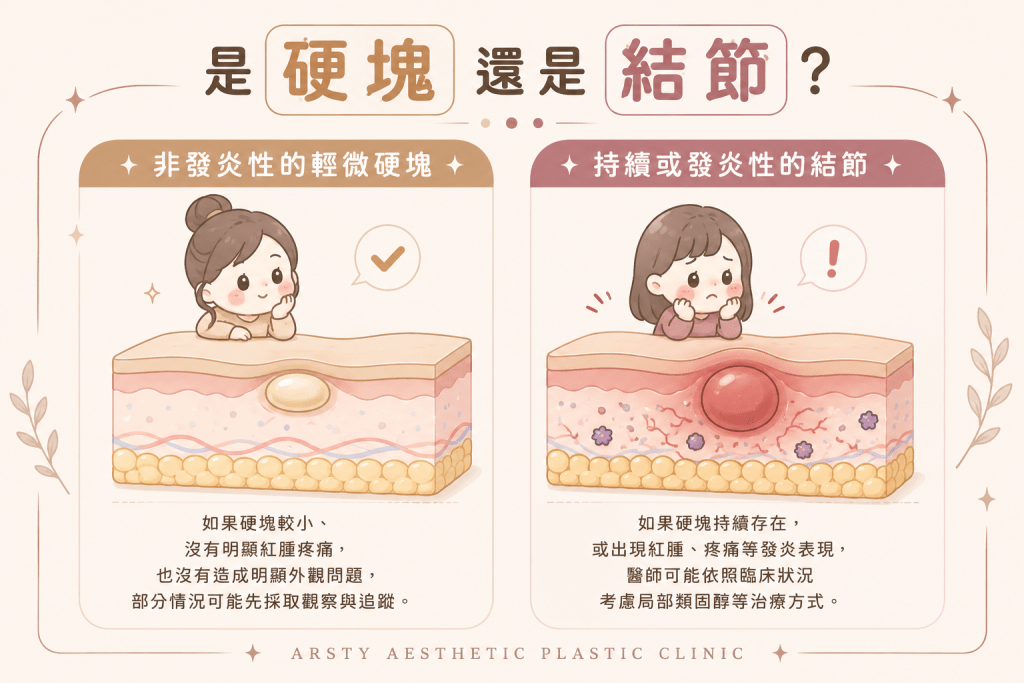
The first type: non-inflammatory, minor lumps
If the lump does not show obvious signs of inflammation such as redness, swelling, pain, or fever, and the symptoms are mild, the doctor may first observe and track it based on the size, location, and changes of the lump.
Not all non-inflammatory lumps require immediate treatment; whether further treatment is needed should be determined by a physician based on clinical presentation.
The second type: persistent or inflammatory nodules
If the lump persists, or if inflammation such as redness, swelling, or pain occurs, the doctor will assess the appropriate treatment based on the actual situation. In some cases, topical steroids may be considered.
For more complex, recurrent, or severe inflammatory nodules, relevant literature has discussed local injections, systemic drugs, or other immunomodulatory approaches. If infection is suspected, further investigation to determine the cause and appropriate treatment are necessary. However, current clinical evidence for some PDLLA nodule treatments remains limited, and the actual treatment approach should be assessed on a case-by-case basis.
In other words, not all Juvederm lumps are suitable for direct use of steroids, and not all nodules require immediate treatment. The type and cause of the lump should be identified first, and then a doctor should assess the appropriate treatment method.
Why can't I use "hyaluronic acid dissolving enzyme" to treat it myself?
Juvederm contains PDLLA and HA, and is not the same material as simple hyaluronic acid fillers. Hyaluronidase mainly acts on hyaluronic acid and cannot directly break down PDLLA. Therefore, if PDLLA-related nodules are formed, they cannot be treated simply with hyaluronidase like regular hyaluronic acid fillers.
Therefore, if a lump appears after receiving Juvederm injections, it is not recommended to seek "dissolving injections" on your own or receive undiagnosed treatment. Instead, a doctor should first confirm the cause and type of the lump and then assess the appropriate treatment method.
How to reduce the risk of Juvederm nodules? Precautions before, during, and after treatment are essential.
While no medical treatment can guarantee that there will be no adverse reactions, proper monitoring and care before and after treatment can help reduce unnecessary risks.
Before administration: Confirm product source and conduct physician evaluation.
First, it should be confirmed that the medical equipment used is legally approved and of a clear origin, and then an assessment should be conducted by a physician based on the treatment site, individual condition, and actual needs.
In addition, you can proactively confirm the product name, license information, and batch number so that you can provide complete information to the doctor for judgment if any adverse reactions occur.
During administration: Do not only pursue high doses
Qiao Yalu's treatment plan is not simply about comparing "how many bottles" or "how much dosage," but rather requires assessing the appropriate treatment method based on the treatment area, skin and soft tissue conditions, and individual circumstances.
Furthermore, PDLLA-related literature indicates that factors such as product preparation, injection technique, injection depth, and material distribution may all be related to nodule formation. Therefore, product preparation and injection methods during treatment are also quite important.
After application: Observe for changes, and do not touch the area repeatedly on your own.
If mild swelling, bruising, or local discomfort occurs after the treatment, you can observe according to the postoperative care instructions provided by your doctor.
If you feel any bumps, do not press, knead, or massage them yourself out of anxiety. Whether massage is needed, the method of massage, and the duration should be based on the product instructions and your doctor's advice.
Conclusion: If a lump is found on a woman's nipple, determine the cause before taking any action.
Juvederm nodules cannot be diagnosed simply by feeling a lump after treatment. Short-term swelling, temporary tissue reaction, and material distribution can all cause a local granular feeling or change in texture. If the lump persists, gradually becomes more noticeable, or is accompanied by symptoms such as redness, swelling, heat, and pain, it is recommended to have a doctor further evaluate the condition to confirm the cause before deciding on the appropriate treatment.
If you have any questions about the Juvederm treatment, injection site, or lumps that appear after the procedure, it is recommended to choose a legitimate medical institution where a doctor can assess your condition based on your individual circumstances, injection site, and actual symptoms. If necessary, imaging examinations can be used to assist in the diagnosis.
Common Q&A about Juvederm nodules: A quick overview
Q1: After Qiao Yalu had the injection, there was a hard lump. Does that mean it has formed a nodule?
Short-term swelling, bruising, or changes in local sensation after treatment may simply be a temporary tissue reaction following the injection. Whether it is a nodule requires a comprehensive assessment based on factors such as the duration, size, location of the lump, and whether it is accompanied by inflammatory symptoms.
If the lump does not improve over a long period of time, or becomes more and more obvious, it is recommended to return to the doctor for confirmation.
Q2: Will the nodules of Jugialu disappear on their own?
For some nodules without obvious signs of inflammation, clinical observation and follow-up may be adopted first, but not all nodules will disappear on their own.
Current research on PDLLA nodules still includes case reports, case series, and other observational data. Evidence for some treatments remains limited, therefore it cannot be guaranteed that all nodules will disappear on their own.
If the lump persists, a doctor should determine whether further treatment is necessary.
Q3: Can Juvederm nodules be dissolved with hyaluronidase?
Hyaluronidase primarily targets hyaluronic acid, while Juvederm contains PDLLA. Therefore, if PDLLA-related nodules are formed, they cannot be directly "dissolved" with hyaluronidase in the same way as regular hyaluronic acid fillers.
Whether treatment is necessary and what method is appropriate should be determined first by identifying the cause and type of the lump, and then evaluated by a doctor.
Q4: Does the presence of nodules on Juvederm products indicate that the product is unsafe?
There is existing literature on nodules and inflammatory reactions of PDLLA-type injectable materials, but the formation of nodules may involve different factors such as product preparation, injection depth, material distribution, individual tissue reaction, and infection.
Therefore, once nodules are found, it is not appropriate to judge whether the product is safe or has quality problems based solely on the hardness of the lump. Instead, it is necessary to further confirm the product's source, injection method, and actual cause of formation.
Q5: How long after taking Qiao Yalu should I be concerned if a lump appears?
Mild swelling, bruising, or changes in local sensation may occur shortly after injection and are likely temporary post-injection reactions.
If the lump persists, gradually increases in size, or appears weeks, months, or even longer after the treatment, and is accompanied by abnormal symptoms such as redness, swelling, pain, or fever, it is recommended to return for a check-up.
Some delayed inflammation or immune-related responses may occur at a later time, so it cannot be judged simply by saying "it's been a long time, so it must be okay".