


[Cell Therapy] A New Breakthrough in Neural Regeneration - Stem Cell Exosomes

Brain injury and neurodegenerative diseases are currently known to be irreversible, and most neurodegenerative diseases and brain injuries lead to dementia. In Taiwan, it is estimated that there are already over 270,000 people with dementia, which is a challenge that we must face as we enter an aging society. Besides advanced age, various degrees of trauma, unhealthy lifestyle habits, hypertension, diabetes, chronic stress, and mental illness are all possible factors contributing to brain injury or degeneration. Although recent clinical studies have shown that stem cells hold promise for repairing damage to the nervous system, the surgical implantation of stem cells still carries the risk of complications and the formation of ectopic tissues.
A research team led by Associate Researcher Hua-Jung Li at the Institute of Cell and Systems Medicine, National Health Research Institutes, has achieved a breakthrough after seven years of research. They discovered that by stimulating mesenchymal stem cells using a special technique, they could isolate "stem cell-derived exosomes" with cell-repairing functions. From these exosomes, they identified active substances that promote brain nerve regeneration and brain function recovery. When stem cell exosomes were injected into mice with damaged brains, it was observed that damaged nerve cells could grow synapses, and the number of nerve cells could recover to 60% of their original number. This research shows that stem cell exosomes have a greater ability to promote tissue regeneration than mesenchymal stem cells, while avoiding the risks and side effects of cell implantation surgery, representing a new breakthrough in regenerative medicine. This series of studies was published in the internationally renowned regenerative medicine journal *STEM CELLS Translational Medicine* in 2019 and 2020, and has been featured in international media.
In recent years, stem cell-based regenerative medicine research has made rapid progress due to the discovery of its potential to regenerate and differentiate into various tissue and organ cells. Induced pluripotent stem cells (iPSCs), discovered by Japanese scholar Shinya Yamanaka, are considered a rising star in emerging medicine. Following the Ministry of Health and Welfare's adoption of the "Amendment to the Regulations Governing the Implementation or Use of Specific Medical Technologies, Examinations, Tests, and Medical Instruments" in September 2019, Taiwan's regenerative medicine field officially entered the stage of developing cell therapy products, clinical applications, and tangibly benefiting patients. Although numerous clinical studies have shown that stem cells hold promise for repairing damage to the nervous system, stem cell culture and stable preservation are difficult, and surgical implantation is still required. The complications arising from cell implantation surgery and the possibility of ectopic tissue formation remain major concerns for stem cell therapy.
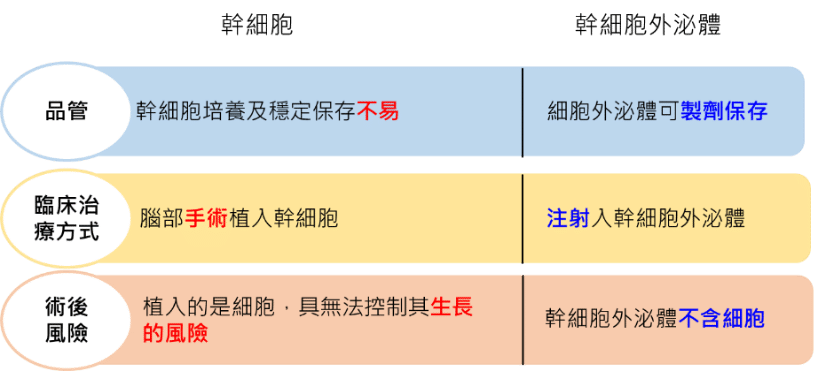
To make stem cell therapy and its potential applications more accessible, and to address the associated negative reactions, the research team focused on discovering the key to stem cells' repair capabilities. Their research revealed that exosomes are tools used by cells to communicate with the outside world, and the messages they carry vary depending on the environment. By stimulating mesenchymal stem cells, which are widely found in bone marrow and adipose tissue, using a special technique, "stem cell exosomes" capable of repairing abnormal cell deficiencies can be isolated. In experiments on mice with brain damage, exosomes with "repair" capabilities were administered via injection. After one week, damaged nerve cells were observed to grow synapses, and after one month, the number of nerve cells in the damaged area recovered to 60% of their original level. Furthermore, the animals' cognitive, learning, and memory functions all improved. Further analysis of the composition of the induced stromal stem cell exosomes developed by the team identified several active substances, including 2′,3′-Cyclic Nucleotide and 3′-Phosphodiesterase, that promote brain nerve regeneration and brain function recovery. This demonstrates that stem cell exosomes possess the ability to promote tissue regeneration. Since surgical implantation of stem cells is unnecessary, the risks and side effects of traditional stem cell therapy can be avoided. Furthermore, automated formulation is possible, making it a potential new direction in regenerative medicine. Dr. Anthony Atala, Director of the Wake Forest Institute for Regenerative Medicine, expressed high expectations: "I look forward to seeing the successful development of this technology in the treatment of brain injury and neurodegenerative diseases."
This technology has obtained a patent in the Republic of China and has been simultaneously applied for patents in the United States, the United Kingdom, and Japan. Dr. Li Huarong stated that although the current research scope of stem cell exosomes is limited to the treatment of neurological diseases, it is expected to be used in the future to treat degenerative diseases, tissue or organ damage, cell defects, neurodegenerative diseases, brain and spinal cord trauma, stroke, learning disabilities, Parkinson's disease, myocardial infarction, muscular dystrophy, and other diseases.


