What is a minimally invasive facelift? Even with small incisions, you can achieve a lifted, younger-looking face and a naturally firm contour!
With the continuous advancement of medical aesthetic technology, more and more people are beginning to examine the risks while pursuing a firm and youthful appearance. They want to improve sagging and aging, but are hesitant due to the long wounds and recovery period of traditional facelift surgery. As a result, in recent years, people have been seeking smarter solutions that can maintain excellent lifting effects while having the advantage of "almost invisible scars". This has made "invisible facelift" a popular choice with a high level of discussion.
What exactly is a "silent facelift"? How does it precisely restore lost facial contours by cleverly concealing incisions using endoscopic assistance and minimally invasive techniques? Is a large incision always necessary for a facelift? Which facelift procedures offer the advantage of being scarless? Read this article to discover the secrets of a silent facelift!
Which facelift surgeries require large incisions?
Some facelift surgeries, such as early forehead lifts (commonly known as forehead lifts) or Face Lifts that improve a larger area, do require longer incisions. This is because in the past, there was no endoscopic assistance. In order to achieve a more obvious and noticeable lifting effect, doctors had to use large incisions to obtain a clear surgical field in order to safely dissect and tighten loose deep tissues.
- Traditional forehead lift: The incision usually runs across the entire hairline on the forehead.
- Face Lift: The incision usually follows the hairline on the temporal side, in front of the ear, around the earlobe, and extends to behind the ear.

The reason why facelift surgery requires a large incision
There are two main reasons:
- Provides a complete field of vision for deep fascial treatment.
A facelift is not just about tightening the skin; more importantly, it's about adjusting the position of the deep fascia (SMAS) and soft tissues. Because there are many important nerves and blood vessels in the face, a professional doctor needs to perform a delicate dissection under a clear view. This is to protect the nerve structures and effectively release ligaments and tissue adhesions in order to achieve a stable and natural lifting effect.
- Remove excess loose skin
When the deep fascia and tissues are re-lifted and fixed, the originally loose skin is prone to developing excess skin. If the degree of laxity is more obvious, the excess skin can be removed through a larger incision, allowing the skin to fit smoothly and restore a natural and firm contour. Therefore, for people with severe skin laxity and a lot of excess skin, a facelift with a large incision still has irreplaceable advantages.
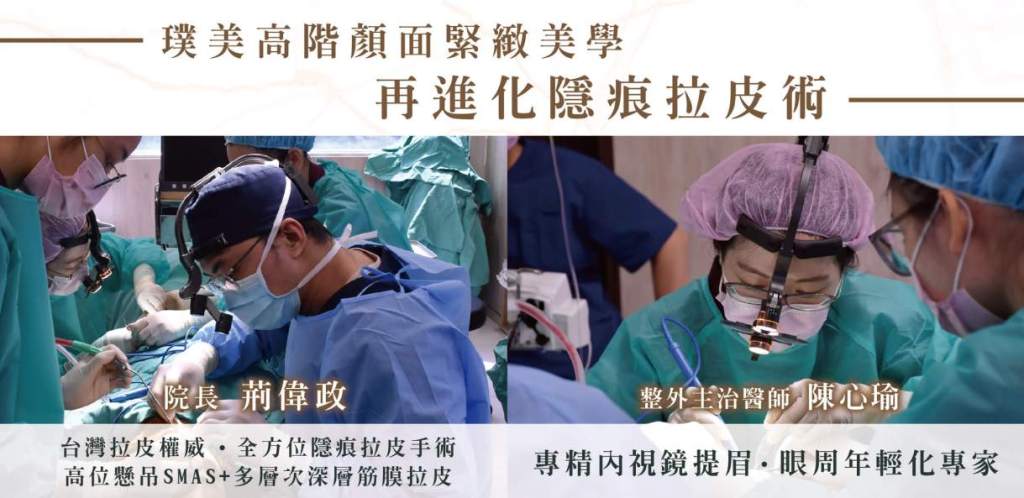
The invisible facelift surgery has been invented, achieving deep lifting effects even with minimally invasive incisions!
With the development of endoscopic technology and doctors' in-depth research on facial anatomy, various scarless facelift surgeries have gradually emerged. Especially with the assistance of high-resolution endoscopes, doctors can enter the surgical area through smaller incisions and perform precise operations under magnified vision, achieving a lifting effect that previously required larger incisions. This not only effectively relaxes ligaments and repositions tissues, but also precisely protects nerves and blood vessels, reducing tissue trauma and shortening the recovery period, making facelift surgery an easy way to enhance beauty!
(one)Endoscopic brow liftTargets signs of aging on the upper face, improving issues like brow and eye wrinkles, and forehead wrinkles.
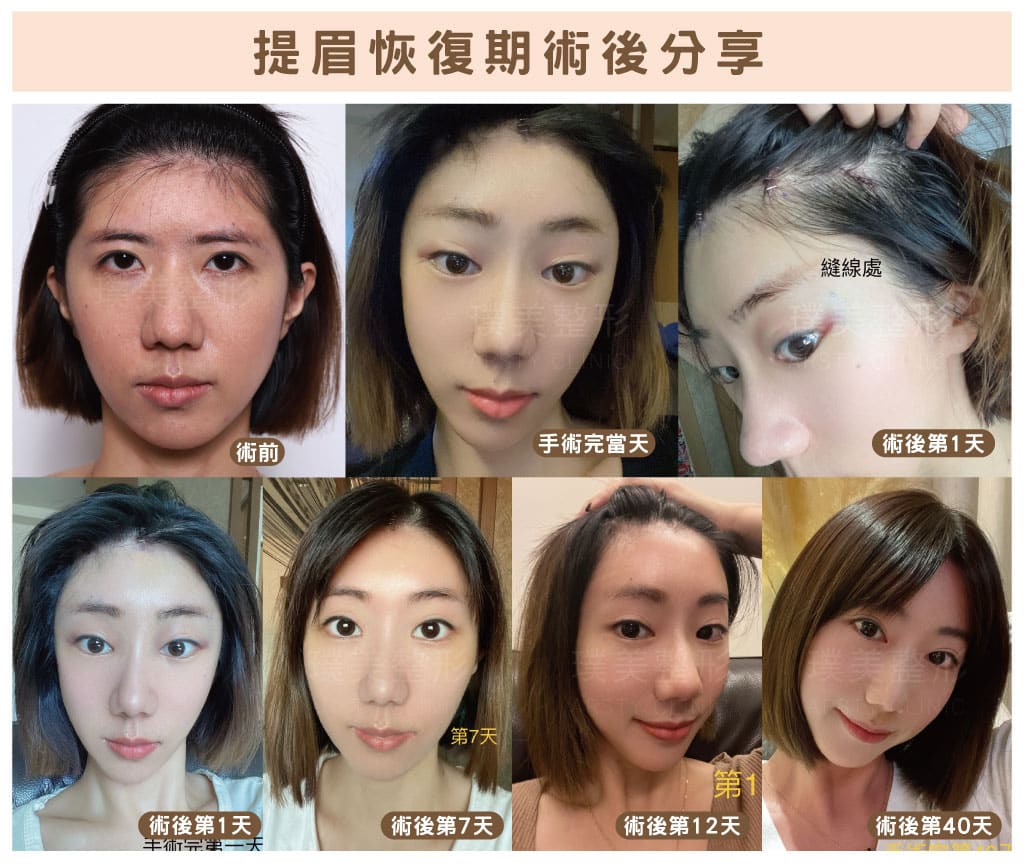
The forehead and eyebrow area are among the first areas to show signs of aging. As the eyebrows gradually droop, you may find that your face is prone to looking worried, and you may even experience eye symptoms such as: eyebrows pressing down on the eyes, sagging eyelids, drooping eyebrows and eyes, and dull eyes. These can be effectively improved through Endoscopic Forehead Lift surgery. The minimally invasive incision for Endoscopic Forehead Lift is hidden in the hairline, so it is not noticeable unless you look closely.
During the surgery, the doctor uses an endoscope to penetrate deep into the forehead area, precisely relaxes the ligaments around the forehead and eyes, and repositions the sagging tissue upwards. This not only improves the pressure between the eyebrows and eyes, but also makes the eyes appear more energetic, without affecting natural facial expressions.
(II) Subtle Face Lift: Improves sagging cheeks and nasolabial folds
Mid-face aging often results in sagging cheeks, deepened nasolabial folds, and tired-looking eyes. Mid-face lift surgery can reposition sagging mid-face tissues upwards, improving mid-face hollowing and laxity. However, it's important to note that mid-face aging only accounts for a portion of overall facial aging, as aging is a holistic process. Most people experience a combination of aging symptoms, including not only mid-face aging but also drooping eyebrows and loose eyelids in the upper face, or sagging around the mouth and a blurred jawline in the lower face. Therefore, in clinical practice, mid-face lift is often combined with Endoscopic Forehead Lift, Face Lift, full facelift, or blepharoplasty to achieve a more balanced facial contour and a more noticeable and natural rejuvenation effect.
Depending on the procedure, the so-called hidden-scar facelift can be broadly divided into two types:
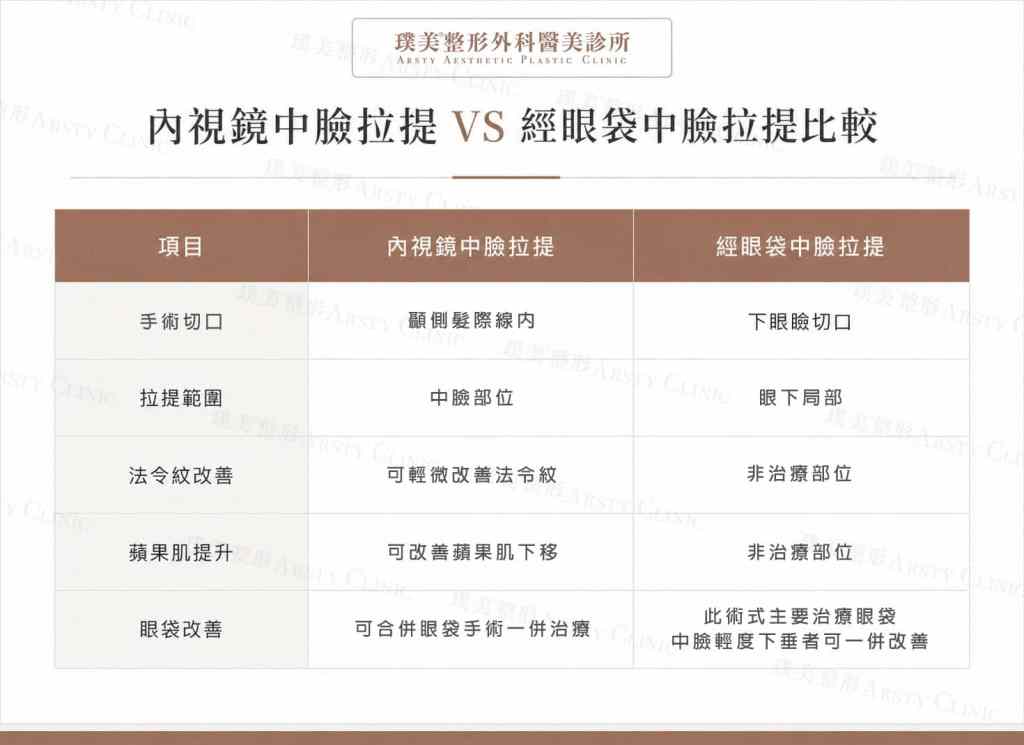
A: Endoscopic midface lift
This procedure is suitable for those with minimal excess skin and mild mid-face sagging, who are at the onset of early signs of aging. Since there is no excess skin to address, a temporal incision is a suitable approach.Endoscopic facelift。
The surgery is mainly performed through a minimally invasive incision along the hairline on the temple side. The doctor uses an endoscope to relax the ligaments around the eyes and midface, and moves the sagging tissue upward and fixes it in the temple side position, re-establishing the midface support structure of youth, achieving a natural lifting and tightening effect.
B. Eyelid bag removal and mid-face lifting: Obvious eye bags and excess skin under the eyes
Suitable for those with mid-face aging, as well as noticeable eye bags, tear troughs, and sagging under-eyes. The surgery can be combined with eye bag surgery, entering through the lower eyelid incision. In addition to treating eye bags and under-eye folds, it can also simultaneously release mid-face ligaments and reposition sagging fat pads and soft tissues to a more youthful position.
Because the wound is hidden in the lower eyelid, it has the advantage of being inconspicuous and not easily noticed after surgery.

(three)Hidden scar Swan Neck LiftImproves a blurred jawline and double chin.
Besides the upper and mid-face, aging of the lower face and neck is also a concern for many people. Common symptoms include a disappearing jawline, sagging around the mouth, double chin, and neck laxity. If the skin laxity is not yet severe, but the facial contours have begun to blur, a subtle Swan Neck Lift can be considered for improvement.
The surgery involves hiding the incision behind the ear and using an endoscope to help dissect the platysma muscle, relaxing its adhesion to the cervical fascia layer. Once the platysma fascia is re-lifted and fixed, it can not only improve sagging of the lower face, but also re-outline the jawline and neck contour, creating a sleek swan neck line.


Is a hidden facelift suitable for everyone?
Facelifts with minimal scarring have become a popular choice for many facial rejuvenation surgeries in recent years due to their smaller incisions, less noticeable scars, and relatively shorter recovery period. However, facelifts with minimal scarring are not suitable for everyone and require professional evaluation and advice from a plastic surgeon based on individual aging level, skin laxity, amount of excess skin, and desired improvement.
Generally speaking, a facelift with minimal scarring is more suitable for individuals aged 30-50 who are in the early stages of aging, have only mild to moderate facial sagging, good skin elasticity, and desire a lifting effect. Conversely, for those with more pronounced skin laxity, excess skin, or more severe signs of aging, a larger incision facelift is recommended to achieve sufficient lifting and firming effects. Alternatively, different surgical techniques may be combined based on individual circumstances to balance safety, the extent of improvement, and post-operative naturalness, resulting in a more ideal and lasting rejuvenation effect.
Only a professional assessment can determine the most suitable lifting method!
The hidden-scar facelift is a rejuvenation treatment concept that utilizes endoscopy and minimally invasive techniques. It ranges from Endoscopic Forehead Lifts and hidden-scar midface lifts to swan neck surgeries. The surgical method suitable for each person is different and needs to be customized based on the degree of skin laxity, fat distribution, fascia aging, and individual desired results. If you find that your friends seem to have become younger without obvious surgical scars, it is very likely that they have achieved a natural rejuvenation effect through the hidden-scar facelift technique.
If you also want to subtly look younger, we recommend making an appointment for a consultation so that a professional plastic surgeon at Arsty Clinic can conduct a detailed evaluation and recommend the most suitable rejuvenation plan for you!